
Tips & Ideas
The Ultimate Secrets of Interior Designing
Jun 30, 2025 · 2 min read
What is Interior Design?
Interior design represents the discipline of creating appealing spaces for occupants' comfort and satisfaction. The scope encompasses everything from permanent structures like homes to mobile environments such aircraft. Practitioners address acoustics, textiles, color schemes, furnishings, safety measures, and the overall sensory experience. The field aims toward "minimalism and perfection in our home, park, and community.
What does an interior designer do and why do we need them?
Designers translate client preferences into tangible environments. They oversee multiple specialists managing lighting, acoustics, furniture, safety, and color coordination. The comprehensive process involves documentation, safety assessments, spatial planning, and inclusive design principles.
Designers typically engage before construction begins, guiding structural decisions. They also work with existing spaces, occasionally removing walls to achieve design objectives, though they generally adapt to available conditions.
Interior designing principles
- Emphasis: Focal points anchor designs. "Emphasizing objects anchors the design," allowing designers to direct attention strategically while de-emphasizing unwanted areas.
- Contrast: Opposing qualities in shape, texture, color, material, and scale create visual interest. Examples include "black and white, rough and smooth surfaces, square vs round shapes.
- Rhythm: Repetition and pattern create visual movement. Replicating "elements, shapes, patterns, and colors tie a design together.
- Balance: Visual weight distribution occurs through three approaches:
- Radial: Elements radiating from a central point
- Symmetrical: Mirrored elements on both sides of a central axis
- Asymmetrical: Similar but non-mirrored elements along an imaginary axis
- Scale and Proportion: Scale determines item suitability for spaces; proportion addresses how furnishings relate to one another.
- Harmony: Achieving cohesion where "each unique item fits together" despite differences, through coordinated color, texture, and shape principles.
Best interior design ideas for your home
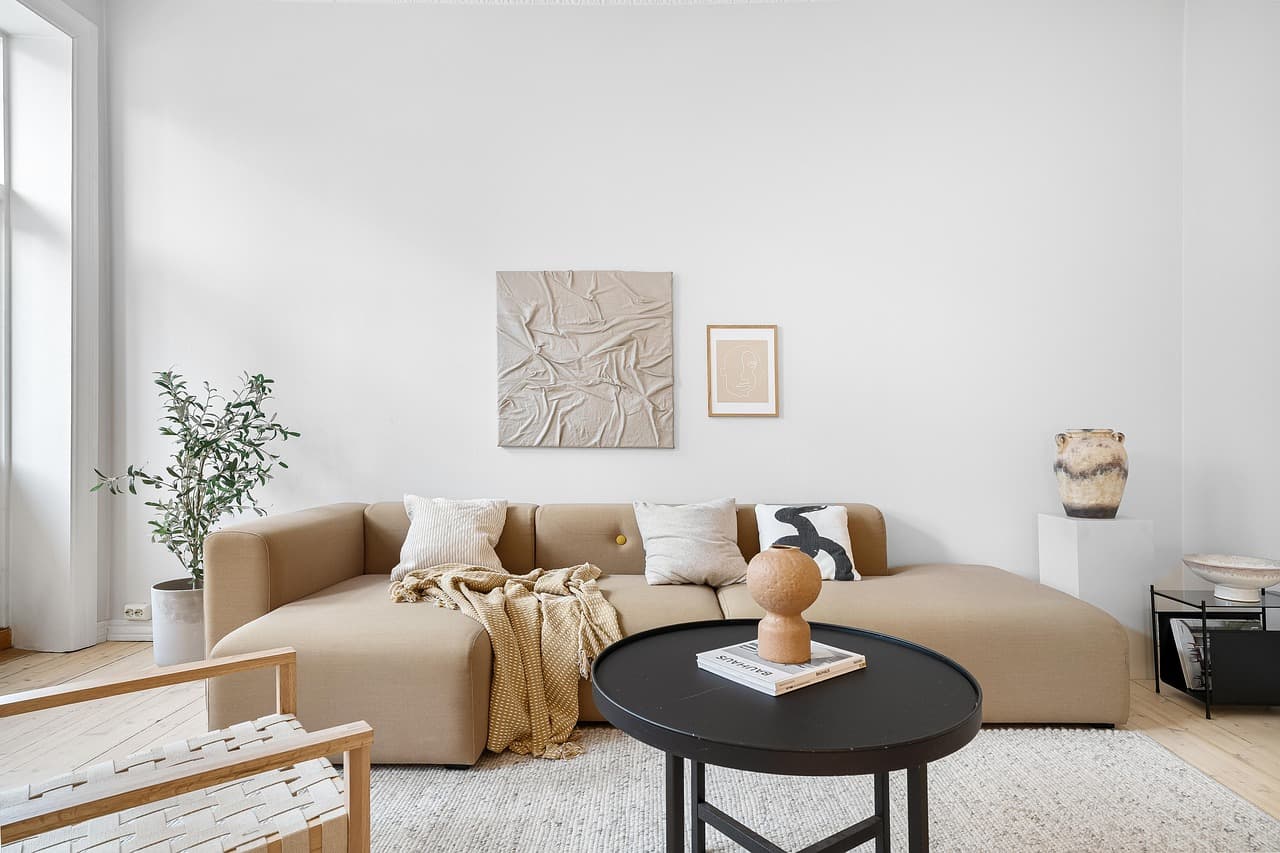
1. Minimalist — The philosophy emphasizes "less is more." Essential characteristics include undecorated elements, clean lines, simple materials, natural lighting, minimal clutter, natural flooring, plants, and wood. Furniture serves functional purposes only. Color palettes restrict to black, white, and grey.
2. Rustic — Natural materials like wood and stone dominate through furniture, ceilings, and walls. Handmade elements are essential. Color schemes draw from nature's palette: grey, brown, black, tan, dusty red, adobe orange, and greens.
3. Contemporary — This approach combines modern sensibilities with urban style, elegant textures, and clean lines. Neutral, black, and white dominate color schemes. Furniture features bold statements without excessive ornamentation. Pieces typically display exposed legs. Large plants with dramatic foliage in simple containers complement the aesthetic.
4. Mid-century Modern — Characterized by simple forms, organic influences, functionality, and minimal decoration with playful elements. Open-space concepts and geometric design emerge prominently. Warm, natural color palettes include olive green, mustard, orange, yellow, and pink. Quality craftsmanship and practical innovation distinguish furniture selections.
---
Contact Information:
- Address: Teku Road, Tripureshwor
- Phone: 015315365, 9851365901, 9851365905
- Email: info@ultrainterio.com